
Blog
How to Choose the Right Sportswear: A Complete Guide for Serious Athletes

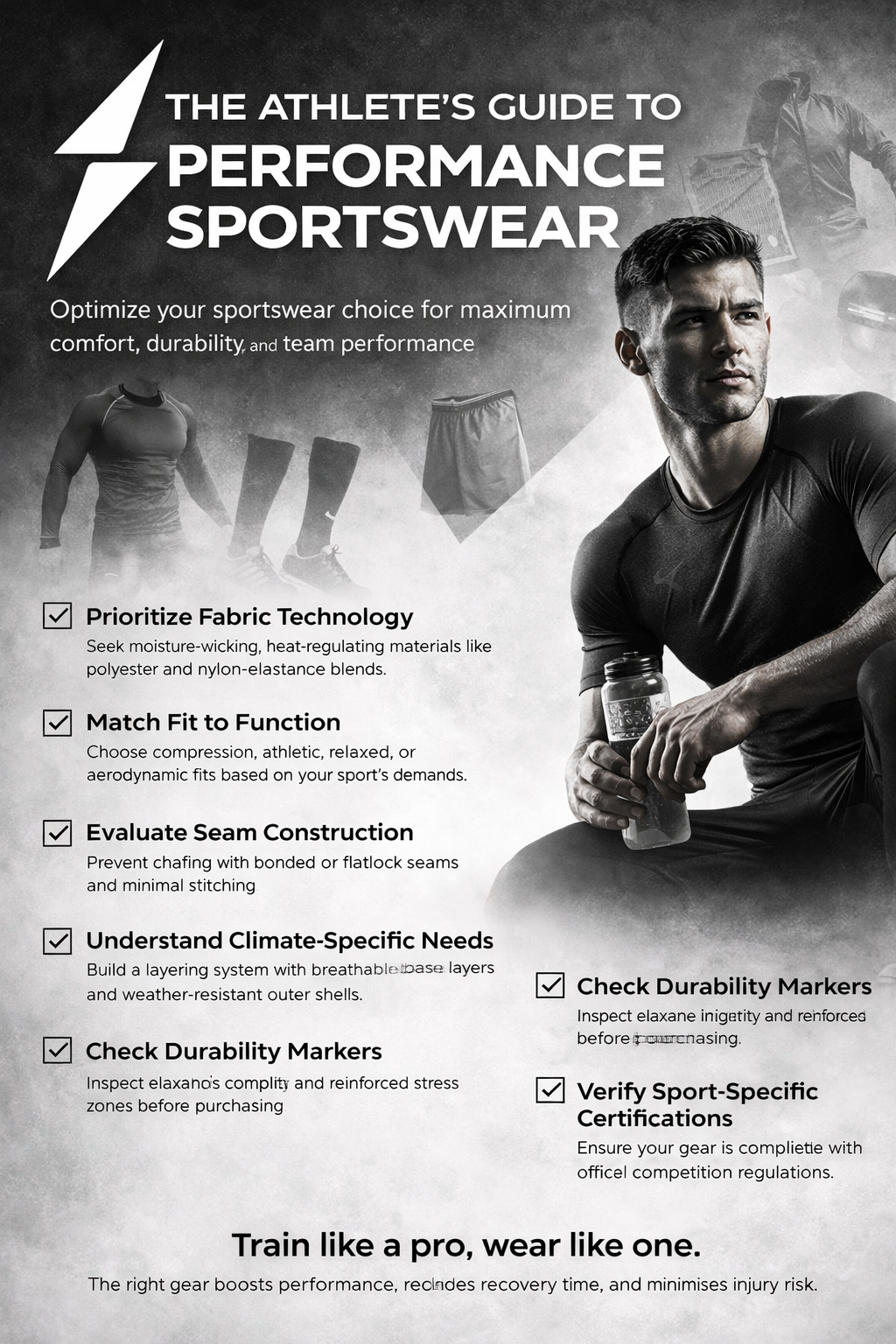
For serious athletes, sportswear is far more than a uniform. The fabric you choose, the fit you wear, and the technology embedded in your kit can meaningfully affect endurance, recovery, and even injury risk. This guide cuts through the noise and gives you a systematic framework for choosing sportswear that actually performs.
1. Prioritise fabric technology
Fabric is the foundation of every performance garment. The two core properties to evaluate are moisture management and thermoregulation. Modern synthetic blends — particularly polyester and nylon-elastane composites — are engineered to wick sweat away from the skin and accelerate evaporation, keeping your core temperature stable during high-intensity efforts.
Pro tip
Look for garments with a GSM (grams per square metre) rating suited to your activity. Low GSM (120–160) is ideal for speed work and hot conditions; higher GSM (180–220) offers durability and compression for strength training.
Avoid cotton for training — it absorbs moisture and holds it, creating chafing risk and significant heat loss in cold conditions. Reserve cotton for recovery wear only.
2. Match fit to function
The cut and compression level of your sportswear should align with your specific discipline. There is no single “best fit” — there is only the right fit for the task.
- Compression fit — Supports muscles, reduces oscillation during running, and aids venous return. Best for endurance sports and post-training recovery.
- Athletic fit — Follows body contours without restriction. The standard choice for court sports, gym training, and functional fitness.
- Relaxed fit — Maximum range of motion. Optimal for martial arts, yoga, and strength-focused sessions where power transfer is not a priority.
- Aerodynamic fit — Close-to-skin with seam minimisation. Essential for cyclists, sprinters, and triathletes where drag matters.
3. Evaluate seam construction
Seams are where garments fail athletes — both in performance and comfort. Flatlock seaming lies flat against the skin, eliminating the ridges that cause chafing during repetitive-motion sports. Bonded seams go further by removing thread altogether, using heat-welded joins that are both lighter and smoother.
“A poorly positioned seam on a 20-kilometre run can become the only thing you think about for the final 10.”
When evaluating a new garment, physically run your fingers along every seam — particularly at the shoulders, inner thighs, and underarms. If it catches, it will cause problems under load.
4. Understand climate-specific requirements
The same athlete needs different gear depending on conditions. Training in a single kit year-round is a performance compromise. Build a layering system with clear roles for each piece.
- Base layer — Direct skin contact. Responsible for moisture management. Choose a lightweight wicking fabric regardless of external temperature.
- Mid layer — Thermal regulation in cold conditions. Merino wool blends offer excellent warmth-to-weight ratio with natural odour resistance.
- Outer layer — Wind and water resistance for outdoor training. Prioritise breathability rating (measured in g/m²/24h) over waterproofing alone.
5. Check durability markers before you buy
Performance fabric degrades. Elastane fibres weaken with repeated washing and UV exposure; polyester can pill after abrasion. Before purchasing, examine stitch density, thread count at stress points (waistbands, cuffs, knee patches), and whether the garment has reinforced zones in high-friction areas.
What to look for
Always check the care label. Garments rated for machine wash at 40°C with standard detergent will last far longer in a training rotation than those requiring specialist cleaning. Longevity is part of value.
6. Do not overlook sport-specific certifications
For competitive athletes, technical compliance matters. Many sports governing bodies regulate permissible garment specifications in competition. Compression sock heights, brief dimensions in triathlon, and swimsuit surface textures are all subject to rules. Verify that any competition-day kit meets the relevant federation standards before race day — not on it.
At the elite level, look for garments developed in collaboration with sports science institutions, which will typically carry documentation of independent performance testing. Marketing claims and verified data are not the same thing.
Final word
Choosing the right sportswear requires the same analytical approach you bring to training load, nutrition, and recovery. Treat it as a performance investment. Understand the fabric, match the fit to the discipline, inspect the construction, and build a climate-appropriate kit system. The right gear will not make you an athlete — but the wrong gear can hold one back.
Browse more guides ↗Shop performance gear at www.newsportswears.com