Inside a Sialkot Sportswear Factory: Behind-the-Scenes Tour

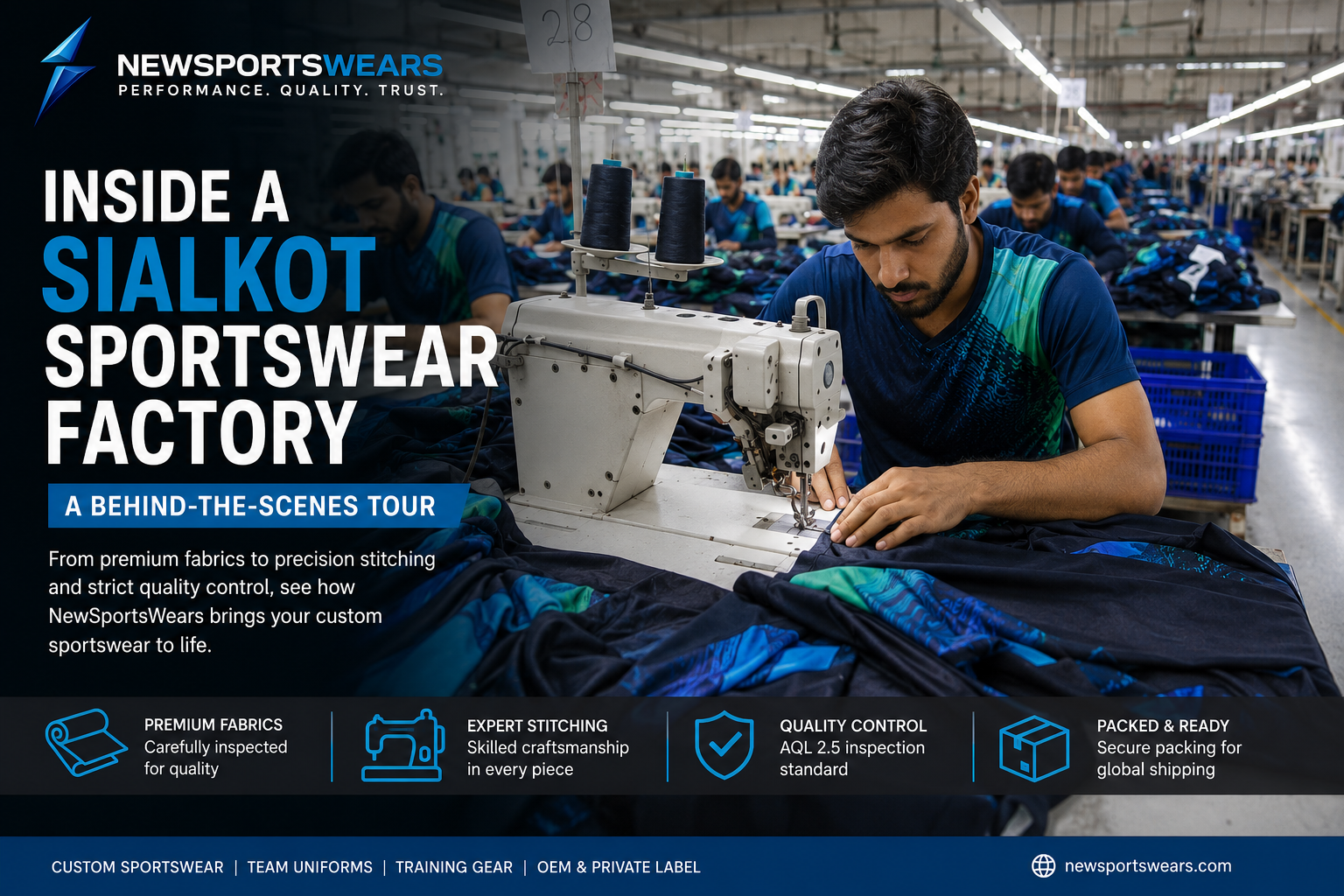
Inside a Sialkot Sportswear Factory: A Behind-the-Scenes Tour
Sialkot, Pakistan produces a remarkable share of the world’s hand-stitched footballs, custom sports kits, and performance apparel. Most overseas buyers never get to walk through a Sialkot sportswear factory in person, so this guide gives you a structured tour of how a typical NewSportsWears production order moves through our facility — from incoming fabric to packed export carton. If you’re sourcing custom sportswear from Pakistan, knowing what happens inside the factory helps you ask better questions, set realistic timelines, and spot good manufacturers from weak ones.
Why Sialkot? A Quick Context Sialkot Sportswear Factory
Sialkot has been a sports manufacturing hub for over a century. The city’s ecosystem is dense: fabric mills, sublimation printers, embroidery houses, accessories suppliers, and stitching units all operate within a few kilometers of each other. That cluster effect lets factories like NewSportsWears produce custom sportswear at competitive prices with short internal lead times — most components are sourced within the city.
Stop 1: Fabric Receiving and Inspection Sialkot Sportswear Factory
Production starts with fabric. Rolls arrive from local and imported mills — interlock, pique, mesh, French terry, recycled polyester, and four-way stretch fabrics are the most common. Every roll is checked for:
- GSM (grams per square meter) — verified with a circular cutter and scale.
- Color match against the buyer’s approved Pantone swatch under D65 lighting.
- Visual defects: weaving flaws, color streaks, holes. Sialkot Sportswear Factory
- Shrinkage tested with a wash sample before bulk cutting.
Rejected rolls are sent back to the mill. Approved fabric is logged into our inventory system and assigned to a specific PO.
Stop 2: Pattern Making and Marker Layout
Pattern masters convert tech packs and graded size charts into digital patterns using CAD software. Markers (the layout that arranges pattern pieces on the fabric to minimize waste) are generated and printed. Good marker efficiency typically runs 82–90% — meaning 10–18% fabric waste, which is the industry benchmark. Sialkot Sportswear Factory
Stop 3: Sublimation Printing (For Printed Kits)
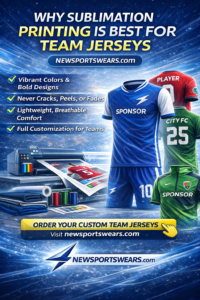
For sublimated football kits, basketball jerseys, cycling kits, and esports apparel, fabric panels are printed before stitching. The process: artwork is printed onto transfer paper using sublimation inks, then heat-pressed onto polyester fabric at around 200°C for 45–60 seconds. The dye sublimates into the fabric fibers, producing prints that don’t crack, peel, or fade. Each panel is checked against the approved color proof.
Stop 4: Cutting
Layered fabric (printed or solid) is cut using either straight knife cutters for smaller batches or automated cutting machines for larger runs. Each bundle is tagged with size, style, and PO number. Bundles move to embroidery if the design requires it, otherwise straight to stitching.
Stop 5: Embroidery and Heat Transfers
Logos, sponsor patches, and crests are added at this stage. Multi-head embroidery machines run digitized files. For higher-end orders we add 3D puff embroidery, silicone heat-transfer prints, or stitched-on woven labels. QC inspectors check stitch density, thread color, and placement against the spec sheet.
Stop 6: Stitching Lines Sialkot Sportswear Factory
This is the heart of the factory. Stitching is organized into production lines, where each operator handles a specific operation: collar attachment, sleeve setting, side seams, hem, label attachment, etc. A single jersey passes through 12–18 operations before it’s finished. Sewing machines used include flatlock, overlock, lockstitch, bartack, and coverstitch — each suited to specific seams. Skilled operators in Sialkot typically have 5–15+ years of experience.
Stop 7: Trimming, Inspection, and Pressing
Finished pieces move to the trimming and finishing department. Loose threads are removed, garments are turned right-side out, pressed (steam ironed), and inspected piece-by-piece. Common defect categories: skipped stitches, misaligned logos, incorrect size labels, fabric flaws missed at inspection, or color variation between panels.
Stop 8: Quality Control — AQL Inspection
Before packing, the order undergoes AQL (Acceptable Quality Limit) inspection. We use AQL 2.5 as the default standard for sportswear: a statistically determined sample is pulled from the finished lot and inspected for major and minor defects. If the lot fails, it goes back for 100% rework. Buyers can also send a third-party inspector (SGS, Bureau Veritas, Intertek) at this stage for independent verification.
Stop 9: Packing and Labeling Sialkot Sportswear Factory
Approved garments are folded, polybagged, hangtagged, and packed into export cartons per the buyer’s spec. Each carton gets shipping marks (PO, carton number, dimensions, weight) and is sealed. Pallets are built and shrink-wrapped for export.
Stop 10: Export and Shipping
From Sialkot, finished orders move to Karachi or Lahore for sea freight (Karachi port for ocean containers) or directly to Sialkot/Lahore international airports for air freight. Sea freight to UK, US, Australia, or UAE typically takes 25–35 days. Air freight runs 5–10 days. Door-to-door DDP service is available for orders that need it. We also produce a wide range of sports accessories packed and shipped through the same workflow.
Visiting NewSportsWears in Person
We host bulk buyers and distributors at our Sialkot facility. The nearest international airport is Sialkot International (SKT) with direct flights from the UK, UAE, and Saudi Arabia. Lahore (LHE) is two hours away by road and offers wider international connections. Visa support letters can be issued for business visits.
Frequently Asked Questions
How long does a typical bulk sportswear order take to produce?
Most custom sportswear orders take 25–45 days from sample approval to factory dispatch, depending on quantity, fabric availability, and decoration complexity.
Can I visit a Sialkot factory before placing a bulk order?
Yes. Serious manufacturers welcome buyer visits and provide visa support letters. Plan a 2–3 day visit to see the full production cycle and meet the team.
What certifications should I look for in a Sialkot factory?
Common certifications include OEKO-TEX Standard 100 for fabrics, ISO 9001 for quality management, and BSCI or SEDEX for social compliance. WRAP certification is also common.
Can I send my own quality inspector to the factory?
Yes. Buyers regularly use third-party inspection firms like SGS, Bureau Veritas, or Intertek. Inspections are typically scheduled at the AQL stage before packing.
How is finished sportswear shipped from Sialkot?
Sea freight via Karachi port (25–35 days to most destinations) is the most cost-effective option. Air freight via Sialkot or Lahore airports (5–10 days) is used for urgent or smaller orders. DDP and door-to-door services are available.
Contact NewSportsWears for custom bulk manufacturing, OEM, and private label orders.
Follow Links
Follow New Sports Wears on Instagram
Contact New Sports Wears on WhatsApp